
AI data centres could double their power use by 2030: what the IEA numbers mean for energy markets
IEA data: data centre electricity use could rise from 485 TWh in 2025 to about 950 TWh by 2030. What it means for gas, power and oil, fact and analysis apart.
By Volodymyr Kravchenko Published 4 min read
Short answer
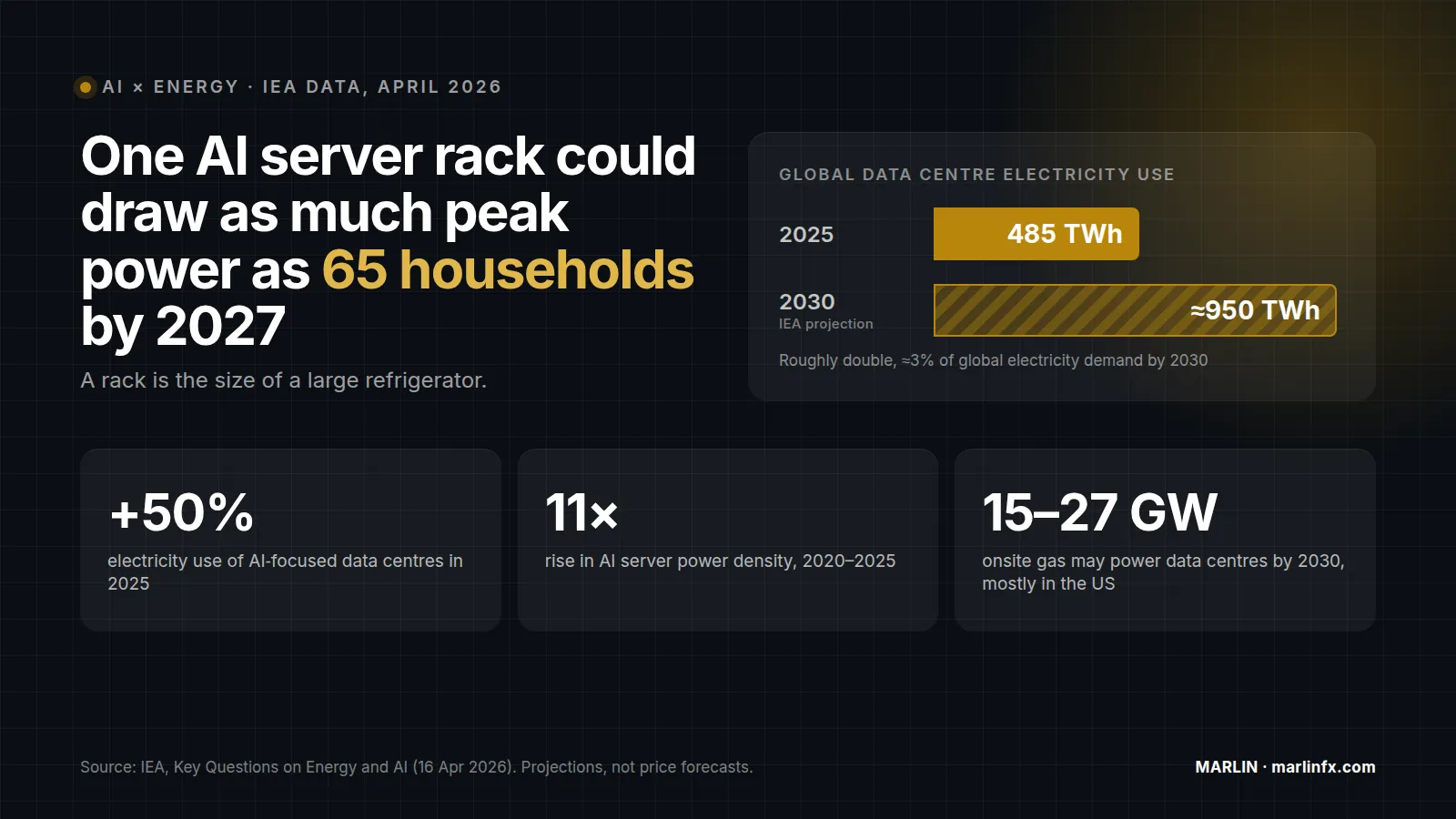
The IEA projects that data centres will use about 950 TWh of electricity in 2030, roughly double the 485 TWh of 2025 and around 3% of global demand. Electricity use of AI-focused data centres rose 50% in 2025. Because grid connections are slow, 15–27 GW of onsite natural gas may power data centres by 2030, mostly in the United States.
Key takeaways
- One advanced AI server rack could have the peak power demand of 65 households by 2027 (IEA).
- Data centre electricity use: 485 TWh in 2025, about 950 TWh in 2030 in IEA projections.
- The bottleneck is grid connection speed; onsite gas generation is filling part of the gap, mostly in the US.
- For oil the direct link is small: data centres run on electricity, not crude.
In mid-September the gas industry’s Gastech exhibition in Bangkok ran a separate exhibition on artificial intelligence, AIxEnergy (14–17 September 2026, organised by dmg events). That a gas event now hosts an AI show says a lot about where AI’s growth runs into physical limits. The International Energy Agency’s April 2026 update, Key Questions on Energy and AI, puts numbers on it.
The numbers
All figures are from the IEA executive summary. Figures for 2027 and later are IEA projections, not measurements.
| Measure | IEA figure |
|---|---|
| Data centre electricity use, 2025 | 485 TWh |
| Data centre electricity use, 2030 (projection) | about 950 TWh, around 3% of global electricity demand |
| Growth in data centre electricity use, 2025 | +17% |
| Growth in AI-focused data centre electricity use, 2025 | +50%; projected to triple by 2030 |
| AI server power density | up 11 times from 2020 to 2025; a further fourfold rise expected by 2027 |
| Peak demand of one advanced server rack, 2027 | equal to about 65 households |
| Onsite natural gas powering data centres, 2030 | around 15–27 GW, mostly in the United States |
| Battery storage in data centres, 2030 | around 20–25 GW |
| Data centre emissions, 2035 | around 350 million tonnes, about 2% of power-sector emissions |
Why the grid is the bottleneck
The IEA’s point is not only how much electricity AI uses, but how concentrated and variable that load is. A server rack the size of a large refrigerator could by 2027 draw at its peak as much power as 65 households. AI data centres also see swings in server load of more than 50% of rated capacity within a second.
Most data centres prefer to connect to the grid. Where connections are slow, developers are building their own gas-fired power. According to the IEA:
- Around 15–27 GW of onsite natural gas may power data centres by 2030, mostly in the United States.
- Satellite tracking of these US projects shows that around one-fifth have started land clearing or construction.
- Reliable onsite gas power for this kind of load needs 30% to 70% more generating capacity than the demand it serves.
- Gas turbine orders rose 70% in 2025, which the IEA says highlighted chokepoints in energy technology supply chains.
The money behind it
The largest technology companies spent more than USD 400 billion on capital expenditure in 2025, and the IEA expects that to rise by another 75% in 2026. By the IEA’s count, capital expenditure of just five technology companies is now larger than global investment in oil and gas production.
There is also a counterweight. The IEA reports that energy use per AI task has been falling by at least an order of magnitude a year, and that a simple AI text query now typically uses less electricity than running a television for the same time. More demanding tasks can use hundreds or thousands of times more energy per query than simple text generation.
What it could mean for energy markets (analysis)
This section is our interpretation, not an IEA finding and not a trading recommendation.
Gas and power are the direct channel. The new demand is for electricity, and the fastest way around slow grid connections is gas-fired generation on site, mostly in the US. For natural gas, AI adds a structural source of demand in the US power sector. The IEA’s 15–27 GW range is wide, and only about a fifth of the tracked projects were under way, so the timing is uncertain.
For oil, the direct link is small. Data centres run on electricity, not crude. Any effect on oil comes indirectly, through faster economic growth. The IEA estimates that an AI-driven growth boost could raise global energy demand by 1–4% in 2035 compared with a path without it. That matters for the long-term demand debate, but it does not move the weekly oil balance.
Keep the scale in proportion. Around 3% of global electricity by 2030 is significant for grids in places where data centres cluster, but it is one driver among many. Week to week, energy prices still respond mostly to supply, weather, inventories and LNG flows. The efficiency gains the IEA describes could also slow demand growth faster than expected.
What to watch
- The weekly EIA reports for US inventories. The EIA petroleum report dates and times are on our calendar.
- Capital expenditure guidance from the largest technology companies in their quarterly results. It is the earliest signal of how much new capacity is coming.
- News on gas turbine supply and on US grid connection delays, the two constraints the IEA highlights.
- The next IEA update. Its numbers are projections and change with each edition. VERIFY CURRENT DATA before citing them.
For the wider context on crude, see our oil market hub, and for rates and growth, the macro hub.
Facts in this item come from the official sources below; sections marked "analysis" are our interpretation, not advice. Nothing here is a trading signal. Read our editorial policy and methodology.
Follow gas and crude on one chart
Put natural gas and crude oil on one watchlist and set alerts before the weekly EIA reports. Check TradingView's current plans on the official site.
Explore TradingViewDisclosure: Some links on this website are affiliate links. If you use them, we may receive compensation at no additional cost to you. This does not determine our editorial analysis, reviews or comparisons.
Sources (4)
ShowHide
Official or primary sources used for the facts above. Figures and terms change, so check the source before acting on them.
- International Energy Agency — Key Questions on Energy and AI: Executive summaryPublished 16 April 2026. Source of every IEA figure in this article.Accessed
- International Energy Agency — Key Questions on Energy and AIAccessed
- International Energy Agency — Energy and AIThe original April 2025 report that the 2026 update builds on.Accessed
- Gastech (dmg events) — AIxEnergy Exhibition, co-located with GastechAccessed
Written by
Volodymyr KravchenkoIndependent market researcher focused on Forex, Gold, commodities, macroeconomic data and AI-powered financial intelligence.
- Forex, gold and oil market research
- Macroeconomic data analysis
- Search-data and SEO analysis
- Website and data-tool building
Educational research, not personal advice. See our editorial policy and methodology.
This content is provided for educational purposes only and is not investment advice. Trading involves risk, and past performance does not guarantee future results. Affiliate relationships may exist. Always conduct your own independent research before making financial decisions.