
MT4 vs MT5 vs cTrader: Which Trading Platform Should You Use?
MetaTrader 4, MetaTrader 5 and cTrader compared: the differences that matter, who each platform suits, and how to choose for forex, gold and oil.
By Volodymyr Kravchenko Published Updated

Short answer
MT4, MT5 and cTrader are the three most widely used retail trading platforms. MT4 is the simple, proven standard for forex. MT5 is more powerful and handles more markets, such as shares and indices. cTrader focuses on a clean interface, depth of market and transparent execution. The best one depends on what you trade and how, not on which is newest.
Key takeaways
- MT4 is the simple forex standard; MT5 adds markets and tools; cTrader focuses on transparency and execution.
- The best platform depends on what you trade and how, not on which is 'newest'.
- Your broker matters as much as the platform — many brokers offer all three.
On this page 8 sections
MetaTrader 4 (MT4)
The platform that defined retail forex trading. MT4 is simple, stable and has a massive ecosystem of custom indicators and Expert Advisors (automated trading robots).
Strengths: proven reliability, huge community, easy to learn, ideal for forex. Limitations: built for forex — less suited to shares/indices, fewer timeframes and order types than MT5. Best for: forex traders who want a no-frills, battle-tested platform.
MetaTrader 5 (MT5)
The successor to MT4 — not just an upgrade, but a broader platform. It handles forex plus shares, indices and other markets, with more timeframes, more order types and a built-in economic calendar.
Strengths: multi-asset, more analytical tools, more order types, faster. Limitations: slightly steeper learning curve; MT4 EAs aren’t directly compatible. Best for: traders who want one platform across forex, indices, shares and metals.
cTrader
Built with a focus on transparency and execution quality. cTrader offers Level 2 depth-of-market, fast one-click trading, and a clean, modern interface. It’s popular with more active and discretionary traders.
Strengths: clean UI, depth-of-market, transparent ECN-style execution, cBots for automation. Limitations: smaller third-party ecosystem than MetaTrader. Best for: active traders who value execution transparency and interface design.
How do MT4, MT5 and cTrader compare?
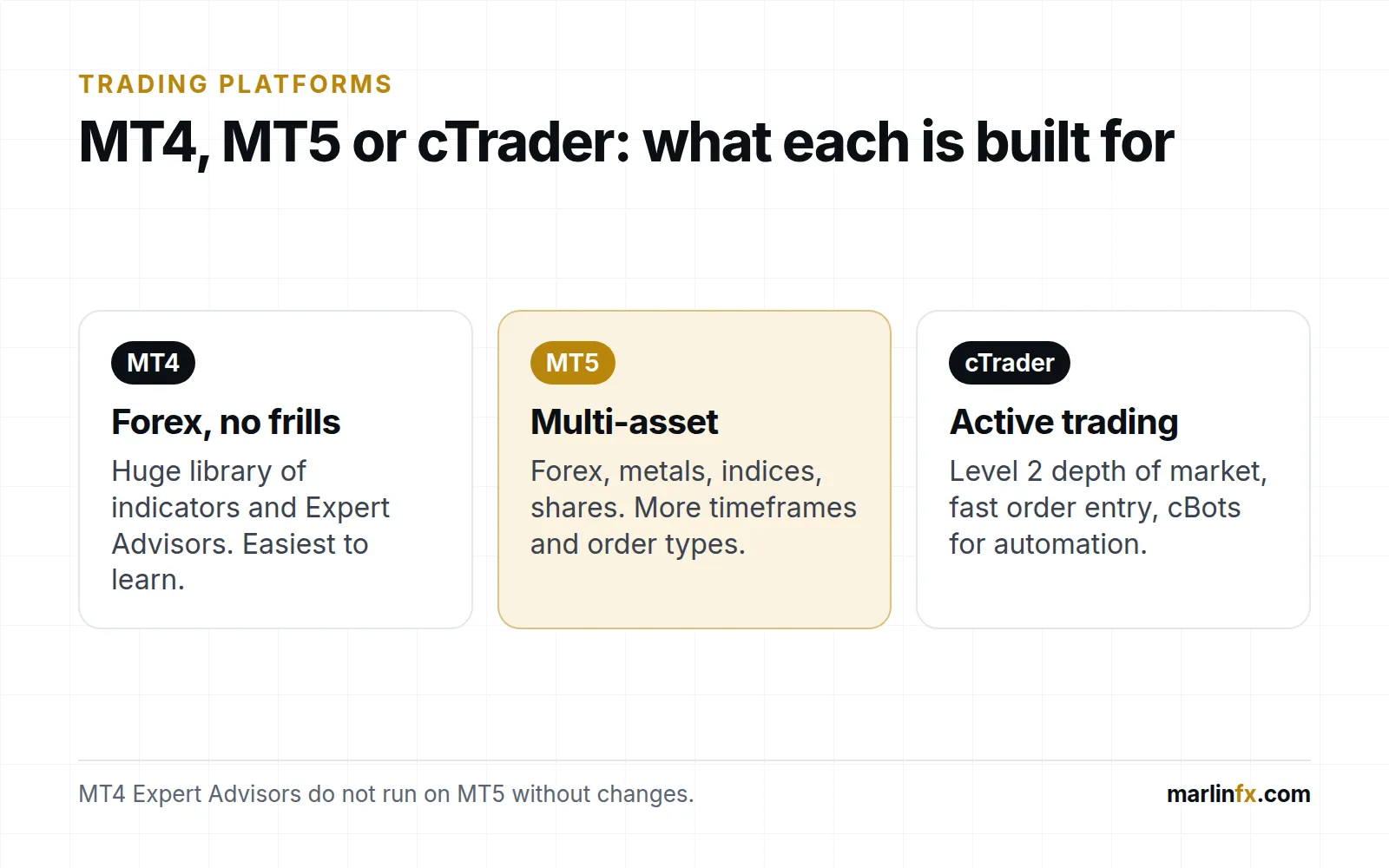
What each platform is built for.
| MT4 | MT5 | cTrader | |
|---|---|---|---|
| Best for | Forex | Multi-asset | Active trading |
| Markets | Forex-focused | Forex, shares, indices | Forex, CFDs |
| Automation | Expert Advisors | Expert Advisors | cBots |
| Depth of market | Limited | Yes | Yes (Level 2) |
| Learning curve | Easiest | Moderate | Moderate |
Which platform should you choose?
- Trading forex only, want simplicity? MT4.
- Trading across forex, gold, indices and shares? MT5.
- Want execution transparency and a modern interface? cTrader.
- Not sure? Pick a broker that offers all three and demo-trade each for a week.
Where does TradingView fit?
MT4, MT5 and cTrader are trading terminals you use through a broker. TradingView is a different kind of tool: a charting and analysis platform that can also route orders to brokers it supports. Many traders analyse in one and execute in the other. See TradingView vs MetaTrader 5 for the comparison.
Does the broker matter?
The platform is only half the equation — the broker behind it handles regulation, execution and your funds. A well-regulated broker with tight spreads will serve you better on any platform than a poor broker on your favourite one.
FxPro, for example, offers all four options — MT4, MT5, cTrader and its own FxPro Platform — under FCA, CySEC and SCB regulation. Read our FxPro review or see the broker comparison to weigh your options.
The bottom line
There’s no single “best” platform — only the best fit for your markets and style. Try each on a demo account, check the broker’s regulation and spreads, and pick the combination that lets you trade your plan with confidence. And whichever you choose, manage risk on every trade — CFDs carry a high risk of losing money due to leverage.
How this was prepared
Method
Written from public, official sources where available and reviewed before publication. Facts are separated from analysis and opinion; anything that could not be verified against a current source is marked VERIFY CURRENT DATA. Read the full methodology and editorial policy.
Sources (2)
ShowHide
Official or primary sources used for the facts above. Figures and terms change, so check the source before acting on them.
- MetaQuotes — MetaTrader 5 trading platformOfficial page for the MetaTrader 5 platform.Accessed
- Spotware Systems — cTraderOfficial page for the cTrader platform.Accessed
Frequently asked questions
What is the difference between MT4 and MT5?
MT4 is a simple, stable platform built mainly for forex, with a large ecosystem of Expert Advisors. MT5 is a broader successor that handles forex plus shares and indices, with more timeframes, more order types and a built-in economic calendar. MT4 Expert Advisors are not directly compatible with MT5.
What is cTrader best for?
Active traders who value execution transparency. It offers Level 2 depth of market, fast one-click trading and cBots for automation, with a smaller third-party ecosystem than MetaTrader.
Which platform should I choose?
Forex only and a no-frills platform: MT4. Forex, gold, indices and shares on one platform: MT5. Execution transparency and a modern interface: cTrader. If you are not sure, pick a broker that offers all three and demo-trade each for a week.
Is TradingView an alternative to MT5?
It is a different kind of tool. TradingView is a charting and analysis platform that can also route orders to brokers it supports, while MT4, MT5 and cTrader are trading terminals used through a broker. Many traders analyse in one and execute in the other.
AdAnalyze markets with the right tools
Advanced charts, indicators and market analysis tools to put this workflow into practice.
Explore FxProDisclosure: Some links on this website are affiliate links. If you use them, we may receive compensation at no additional cost to you. This does not determine our editorial analysis, reviews or comparisons.
Written by
Volodymyr KravchenkoIndependent market researcher focused on Forex, Gold, commodities, macroeconomic data and AI-powered financial intelligence.
- Forex, gold and oil market research
- Macroeconomic data analysis
- Search-data and SEO analysis
- Website and data-tool building
Educational research, not personal advice. See our editorial policy and methodology.
This content is provided for educational purposes only and is not investment advice. Trading involves risk, and past performance does not guarantee future results. Affiliate relationships may exist. Always conduct your own independent research before making financial decisions.
Related articles

Best Brokers for TradingView in 2026: Gold, Oil & Forex
Which brokers let you trade gold, oil and forex directly from TradingView charts, how the connection works, and what to check before you pick one.
Read analysis
Best CFD Brokers & Trading Platforms in 2026: How to Choose
CFD brokers for gold, oil and forex compared: who regulates each one, which platforms they offer, and what changes if you live in the UK, EU or UAE.
Read analysis
Best Gold Trading Brokers: How to Choose in 7 Checks
No single best gold broker. Seven checks for XAUUSD: regulation, costs, hours, platform, margin, funding and protections, plus the brokers we reviewed.
Read analysis